From Aerospace to Asphalt: Why Your Car Has Less Telemetry Than a 1970s Satellite
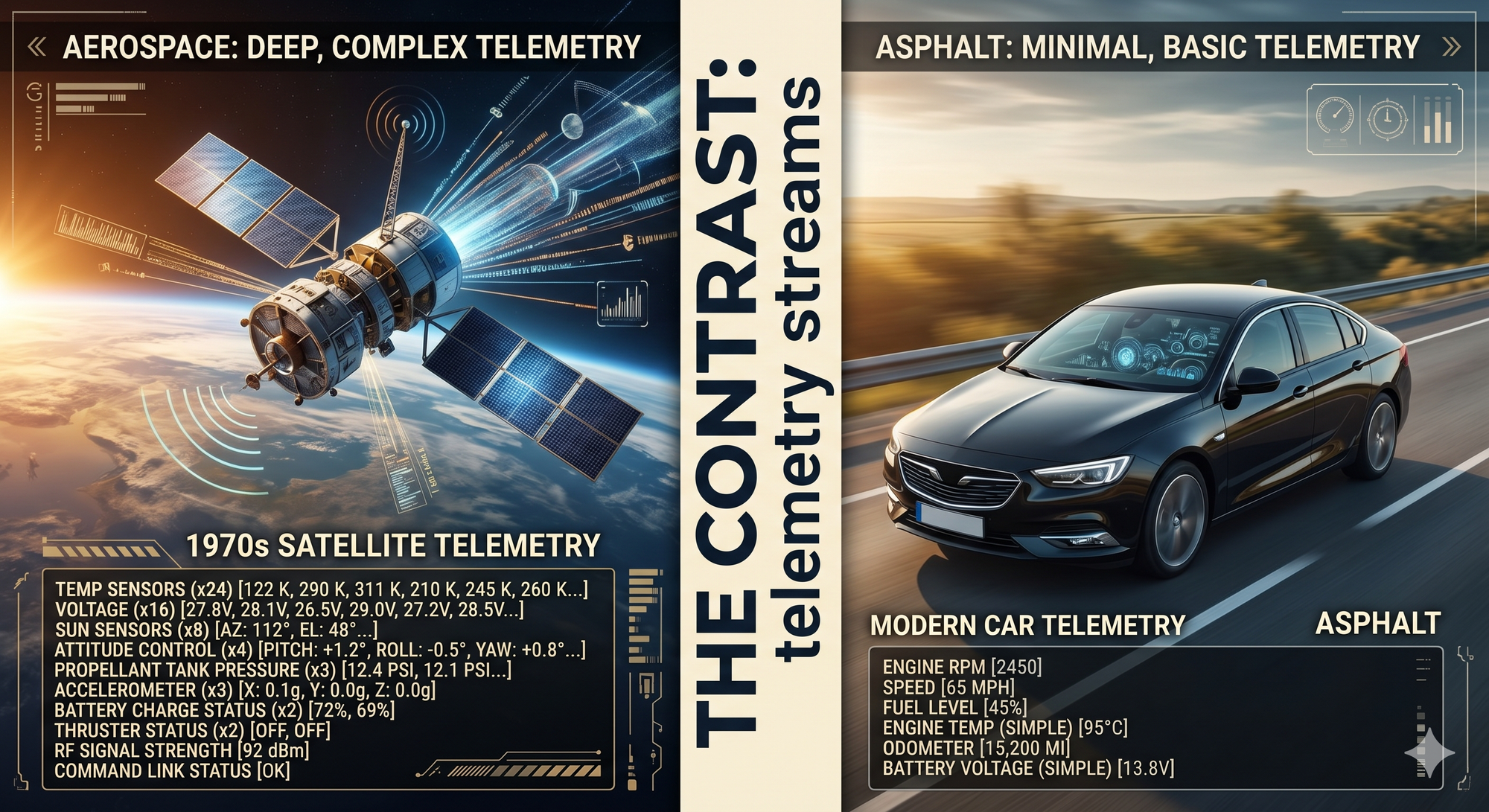
In 1996, the EPA standardized OBD-II. Every passenger vehicle sold in North America since has used essentially the same diagnostic protocol: roughly 10 parameters, sampled at 1 Hz, accessible through a 16-pin port under the dashboard.
In 1978, NASA's GOES-3 weather satellite was reporting telemetry on 2,200 parameters at rates up to 40 Hz — from geostationary orbit, over a bandwidth-constrained S-band link, with 1970s silicon.
Your car has less observability than a 47-year-old satellite.
This isn't a complaint. It's the thing our founding team couldn't stop thinking about.
The gap is structural, not technical
We came out of aerospace and orbital systems engineering. The three of us had spent our careers building the instrumentation around propulsion, attitude control, and power distribution on vehicles that cost nine figures and could not, under any circumstances, fail silently. The discipline that made those systems work wasn't mysterious — it was just exhaustive measurement plus ruthless signal processing.
Then we started looking at cars.
Modern vehicles are, structurally, much more sophisticated than 1970s satellites. A contemporary EV has around 3,000 sensors, 80+ ECUs, and a CAN/Ethernet bus topology that moves gigabytes of data per drive. The hardware is there. The instrumentation is there.
What's missing is the architectural decision to treat that data as signal, not as tripwires.
OBD-II was designed to answer one question: is this vehicle polluting more than the regulation allows? It was built by regulators, for regulators, to enforce emissions compliance. It was never meant to predict failure, assess fleet health, or give you 48 hours of warning before a bearing seizes. It does exactly what it was asked to do and nothing else.
The result: automotive engineers have access to an unbelievable quantity of internal sensor data while the vehicle is running, and almost none of it leaves the car.
Why aerospace got there first
Three reasons, all economic:
-
Satellites can't be towed. If a reaction wheel starts degrading on-orbit, nobody's going up there to replace it. You either detect the drift early and compensate with software, or the spacecraft dies. This forced predictive maintenance into spacecraft engineering from day one.
-
Downtime is catastrophically expensive. A single day of lost transponder time on a commercial communications satellite is a seven-figure revenue event. That math funds a lot of telemetry.
-
The platform operators owned the full stack. NASA, Lockheed, or SES designed the hardware, wrote the firmware, operated the ground stations, and analyzed the telemetry in-house. There were no competing vendor interests to negotiate around.
Automotive has inverted almost all of these. Drivers can be towed. Downtime is irritating but survivable. And the ecosystem is fragmented across OEMs, tier-one suppliers, aftermarket shops, insurers, and fleet managers — none of whom had a natural incentive to build cross-vehicle, cross-brand telemetry intelligence.
Until recently, no one was both technically equipped and commercially motivated to close the gap.
What we ended up building
We started with a simple question: what would a vehicle look like if it was instrumented the way a spacecraft is?
Not more sensors. Better use of the sensors already there. A sampling stack that could pull from the CAN bus at up to 60 Hz, a hardware security module for bus isolation, a neural model trained on fleet-aggregated signatures rather than per-vehicle thresholds, and an event-stream architecture that treats anomalies as first-class data rather than binary alarms.
The engineering problem is the one we already knew how to solve. The interesting work has been the cultural one — convincing drivers, fleet managers, and insurers that "my car is fine because the light isn't on" is approximately as rigorous as "the engine room is fine because nobody smells smoke."
Once that shifts, the rest is arithmetic.
Where this goes
Every domain that has made this transition — aviation, rail, industrial motors, semiconductor fabs, utility-grade power generation — has followed the same curve. First, a small number of operators adopt predictive instrumentation because the ROI is obvious for them specifically. Then insurers start pricing it in. Then regulators codify it. Then it becomes unthinkable to run equipment without it.
Cars are somewhere between step one and step two.
We're building for step four.
The check engine light was a good idea for 1996. It shipped in a world where compute was expensive, bandwidth was scarce, and real-time signal processing required a datacenter. None of those constraints still exist. A Raspberry Pi 5 has more processing power than the ground station that flew Voyager.
There's no longer any technical reason your car should have worse telemetry than a satellite launched during disco. The Neural Sentinel is our argument that it shouldn't.